
Relocating to the United Arab Emirates brings a lot of excitement and endless opportunities for expats. In order to truly settle down and enjoy everything this country has to offer, you will need a UAE Residence Visa. This essential document is what lets you open a bank account, sign a tenancy contract, enroll your children in school, and get a driving license. Without it you are simply a visitor with a running clock.
In 2026, the country will be offering more than 10 active categories. These range from the standard 2-year employment permit to the 10-year self-sponsored Golden Visa, the Green Visa, and the newly launched Blue Visa, which opened for applications in April 2026.
Here, we cover every active category, eligibility requirements, required documents, official fees renewal rules, and all the key 2026 updates you need to know.
What Is a UAE Residence Visa and Who Needs It?
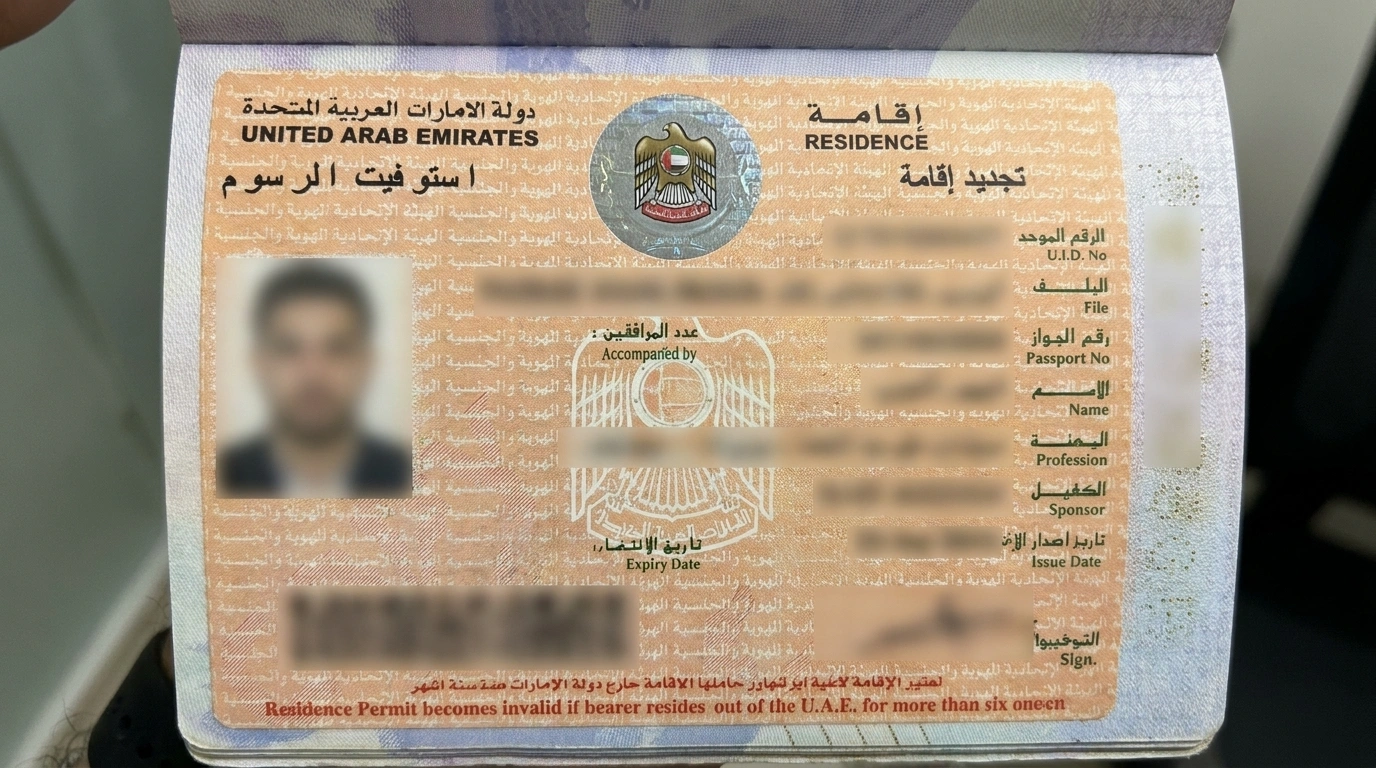
A UAE Residence Visa, officially called a UAE Residence Permit, is a long-term stay authorization issued by the ICP (Federal Authority for Identity, Citizenship, Customs and Port Security) or GDRFA (General Directorate of Residency and Foreigners Affairs) in Dubai. It allows a foreign national to legally live, work, study, or do business in the UAE.
Every expat needs it. Without a valid residence visa, you cannot legally stay in the UAE beyond your visit or tourist visa period. Your visa is always linked to a sponsor, such as your employer, a family member, or yourself in self-sponsored categories. Validity ranges from 1 year to 10 years, depending on the visa type. Once you hold it, you can open a UAE bank account, sign a tenancy contract, enroll your children in school, apply for a driving license, sponsor eligible family members, and access government services and healthcare.
UAE Residence Visa Types 2026: Complete List
The UAE offers more than 10 active residency categories in 2026. Here is the full list:
| Visa Type | Validity | Self-Sponsored | Who It Is For |
| Employment Visa | 2 to 3 years | No | Private sector employees |
| Family Visa (Dependent) | Matches sponsor | No | Spouse, children, parents of residents |
| Investor or Business Visa | 2 to 3 years | No | Business owners, company shareholders |
| Property Investor Visa | 2 years | Yes | Property owners at AED 750,000 and above |
| Student Visa | 1 year | No | Students enrolled in UAE institutions |
| Retirement Visa | 5 years | Yes | Residents aged 55 and above |
| Remote Work Visa | 1 year | Yes | Employees of foreign companies working remotely from UAE |
| Green Visa | 5 years | Yes | Skilled workers, freelancers, investors |
| Golden Visa | 10 years | Yes | Investors, entrepreneurs, top graduates, talented individuals |
| Blue Visa | 10 years | Yes | Environmental and sustainability experts (new in 2026) |
| Domestic Worker Visa | 2 years | No | Maids, drivers, household domestic staff |
Key UAE Residence Visa Types Explained
The government offers several different categories to match your specific reason for moving here. Review the detailed options below to easily find the exact permit that perfectly fits your current situation.
Employment Visa — Most Common
Sponsored by a UAE mainland employer through MoHRE (Ministry of Human Resources and Emiratisation). The employee does not apply directly. The employer or PRO handles the full process.
Validity is 2 years standard, or 3 years in some cases. After completing the medical test and biometrics, the residence visa is stamped in the passport, and the Emirates ID is issued. Employment visa holders also receive a UAE work permit and labour card, which is their legal work authorization in the UAE.
Family Sponsorship Visa
A UAE resident can sponsor their spouse, children under 18 (sons) or unmarried daughters of any age, and their parents. The minimum salary required to sponsor family members is AED 4,000 per month or AED 3,000 plus accommodation allowance.
Golden Visa holders can sponsor a family regardless of the salary threshold. Required documents include an attested marriage certificate, an attested birth certificate, and the sponsor’s residency documents.
Green Visa: 5-Year Self-Sponsored Residency
The Green Visa gives 5 years of self-sponsored residency with no employer needed. It is available to skilled employees with a minimum university degree and a monthly salary of at least AED 15,000. It is also available to freelancers and self-employed professionals with a valid UAE freelance permit, investors in a UAE business, and exceptional talents in specific fields.
As it has lower eligibility requirements than the Golden Visa, it is accessible to a much larger group of professionals.
Golden Visa: 10-Year Self-Sponsored Residency
The Golden Visa is 10-years, self-sponsored, and renewable. Eligible categories include investors with AED 2 million in property or business. Also included are entrepreneurs, scientists, outstanding students, and graduates with a GPA of 3.75 or higher. Additionally, they include individuals with talent in art, culture, sports, medicine, and engineering.
In 2026, new pathways were added for humanitarian pioneers and frontline workers. The full eligibility list and application process for the Golden Visa covers all current categories, including the recent 2026 additions.
Blue Visa: 10-Year Residency for Environmental Experts
The Blue Visa is the UAE’s newest long-term residency category. Applications opened on April 13, 2026. It is 10 years, self-sponsored, and renewable, designed for individuals with exceptional, verifiable contributions to environmental protection, climate action, sustainability, and renewable energy.
ICP has defined 5 eligibility categories: distinguished individuals, research and academic contributors, climate technology innovators, international organization representatives accredited by the UAE MoFA, and sustainability investors.
Key difference from the Golden Visa: there is no property investment route. Eligibility is based entirely on documented environmental contributions. Blue Visa holders can sponsor their spouses, children, parents, and domestic workers. In April 2026, the Blue Visa alone will not grant work rights. A separate work authorization will still need to be obtained from an employer.
Blue Visa Fees: AED 350 nomination fee plus AED 1,250 entry permit fee if applying from outside the UAE.
Retirement Visa: 5 Years for Residents Aged 55 and Above
For residents aged 55 and above with a qualifying financial profile. Must meet a requirement of owning property worth AED 1 million or above with savings of AED 1 million, or having an annual income of AED 180,000 (AED 240,000 in Dubai specifically). A minimum of 15 years of work experience inside or outside the UAE is also required. Valid for 5 years and renewable.
Remote Work Visa: Work for a Foreign Company from UAE
For employees of foreign companies who want to live in the UAE while working remotely. Minimum monthly income: USD 3,500. As of January 27, 2026, six consecutive months of bank statements are now required, up from three months previously. Valid for 1 year and renewable.
UAE Residence Visa Documents Required
Exact documents vary by visa type, but these apply across most categories:
- Valid passport with at least 6-months validity remaining and at least 2 blank pages.
- Passport-size photographs with a white background, recent.
- Medical fitness certificate from an approved UAE health centre.
- Valid UAE health insurance which is mandatory for all residents.
- Emirates ID application submitted as part of the process.
Additional documents by visa type:
| Visa Type | Additional Documents |
| Employment | Signed employment contract, employer trade licence |
| Family | Attested marriage certificate, attested birth certificates |
| Property Investor | DLD property ownership certificate, title deed |
| Green or Golden | Proof of income, degree certificates, relevant approvals |
| Retirement | Bank statements, property proof, income evidence |
| Remote Work | Employment letter from foreign company, 6 months bank statements |
| Blue Visa | Environmental contribution evidence, professional accreditation |
How to Apply for a UAE Residence Visa: Step by Step
The core process is the same across all visa types. The sequence is always: entry permit, medical test, Emirates ID biometrics, then visa stamping.
- Determine your visa category and confirm you meet the eligibility requirements before starting.
- Employer or sponsor submits the entry permit application through ICP or GDRFA. For self-sponsored visas like Golden, Green, or Blue, you can apply directly via the ICP portal.
- Entry permits are issued usually within 1 to 3 working days. This allows you to enter the UAE or change your status if you are already in the country.
- Enter the UAE on an entry permit if you are applying from abroad. If you are already in the UAE, no exit is required. You can change your visa status in-country.
- Complete the medical fitness test at an approved UAE health centre. This covers all blood tests, chest X-rays, and general health screenings. Results are sent directly into the ICP system.
- Complete Emirates ID biometrics at an ICP-approved typing centre or at one of the Customer Happiness Centres. Fingerprints, photos, and personal details are registered.
- The sponsor or PRO submits the residence visa application with all required documents through the ICP or GDRFA portal.
- Visa is approved and stamped in your passport. The validity period starts from the stamp date.
- Emirates ID is issued and delivered via Emirates Post within 5 to 7 working days after biometrics. You can follow the Emirates ID steps after your medical test to make sure nothing is missed at the medical stage.
Status Change Rule 2026: You can convert from one visa category to another without leaving the UAE. The administrative fee is AED 500 to AED 700. ICP or GDRFA approval is required.
Full processing time for a completed file: 5 to 15 working days, depending on the visa type and the emirate. Official applications are submitted through the ICP portal, and guidance is available on the UAE Government’s platform. GDRFA-specific applications are available on the website for Dubai residents.
UAE Residence Visa Cost 2026: Full Breakdown
No single fixed total exists because costs vary by visa type, emirate, and whether a typing centre, PRO service, or direct application is used. Below are the main government fee components:
| Fee Component | Approximate Cost |
| Entry permit fee | AED 100 to AED 500 depending on type |
| Medical fitness test | AED 200 to AED 500 per person |
| Emirates ID (2-year) | AED 300 per year |
| Residence visa stamping | AED 100 to AED 500 |
| Health insurance (mandatory) | AED 500 to AED 5,000 per year |
| Typing centre service fee | AED 25 to AED 200 per transaction |
| Status change fee (in-country) | AED 500 to AED 700 |
Total typical range for a standard 2-year employment residence visa: AED 3,000 to AED 7,000 per person depending on visa type, emirate, and whether health insurance is employer-provided or self-purchased.
2026 Overstay Fine Update: Since February 11, 2026, UAE visa overstay fines have been unified at AED 50 per day across all visa types. The grace period after residence visa expiry is 60 days before fines begin.
How to Renew Your UAE Residence Visa?
Renewal follows the same sequence as the original application: updated medical tests, updated Emirates ID, and a new visa stamp. Start the process 60 days before expiry. ICP allows applications up to 6 months before the expiry date.
The grace period after expiry is 60 days before fines begin. This was updated in February 2026, previously 30 days for most categories. After the grace period, the fine is AED 50 per day. Your Emirates ID renewal always happens at the same time since both documents expire on the same date.
- Submit the renewal application through ICP or GDRFA. For employment visa holders, the employer or PRO handles this submission.
- Complete your medical fitness test.
- Update Emirates ID biometrics if required by ICP.
- Pay the renewal fees.
- New visa stamp is issued in your passport.
- Updated Emirates ID is delivered via Emirates Post.
If your residency is still being processed, you can check your Emirates ID application status through the ICP app or portal while you wait.
UAE Residence Visa Cancellation
When you leave a job, switch employers, or leave the UAE permanently, the visa must be cancelled through the sponsor. For employment visa holders, the employer cancels the work permit and visa through MoHRE and ICP.
After your residence visa is cancelled, you have a grace period of 30 days to exit the UAE or switch to an alternate sponsor. If transferring to another employer, the prospective employer applies for a new entry permit, and no exit from the UAE is required, so the status change can happen in-country.
Emirates ID is cancelled simultaneously with a residence visa. Health insurance tied to the sponsor is also cancelled at the same time. Consider unemployment insurance before your visa is cancelled, as it provides financial protection during the gap between employment.
Frequently Asked Questions
What are the types of UAE residence visas in 2026?
More than 10 categories: employment, family dependent, property investor, Green Visa (5 years), Golden Visa (10 years), Blue Visa (10 years, new in 2026), retirement, student, remote worker, domestic worker, and business investor.
How much does a UAE residence visa cost?
A standard 2-year employment visa typically costs AED 3,000 to AED 7,000 per person in total. This covers entry permits, medical tests, Emirates ID, visa stamping, and mandatory health insurance.
Can I switch visa types without leaving the UAE?
Yes. You can convert from one visa category to another inside the UAE without exiting. This requires a status change approval from ICP or GDRFA and costs AED 500 to AED 700.
What is the grace period after UAE residence visa expiry?
Since February 2026, the grace period is 60 days after expiry before overstay fines begin. After 60 days, fines are AED 50 per day. An exit permit costing AED 250 to AED 300 is also required if you need to exit after more than 30 days of overstay.
What is the Blue Visa?
The Blue Visa is a 10-year self-sponsored residency that launched for applications in April 2026. It is for individuals with exceptional documented contributions to environmental protection, climate action, and sustainability. Unlike the Golden Visa, there is no property investment pathway. Eligibility is based entirely on environmental impact evidence.
How long does UAE residence visa processing take?
With a complete file: 5 to 15 working days from entry permit to final visa stamp. Medical tests and biometrics each take 1 to 2 working days.
Final Thoughts
2026 will be the most diverse year for UAE residency options that the country has seen. Standard employment and family visas remain the backbone. However, the Golden, Green, and now Blue Visas give skilled professionals, investors, and environmental experts long-term self-sponsored pathways without needing an employer to stay.
The core process remains the same, including entry permits, medical tests, Emirates ID biometrics, and visa stamping. That sequence applies to every category. Once you have your visa, track the expiry date and start renewing 60 days out. The grace period is there, but AED 50 per day adds up fast.
Before you travel after any status change, check whether a travel ban affects your departure. And when planning renewals or biometric appointments, always check the UAE public holidays in advance so you do not land in a closed office.

Haris Khan is the lead content expert at TheEmiratesGuides.com, where he oversees the documentation of UAE visa processes, employment opportunities, and government services. With a commitment to factual integrity and real-time updates, he provides the technical expertise necessary to guide readers through the complexities of life and work in the UAE.